
Vehicle Dynamics Simulator for ECU Testing
Technologies
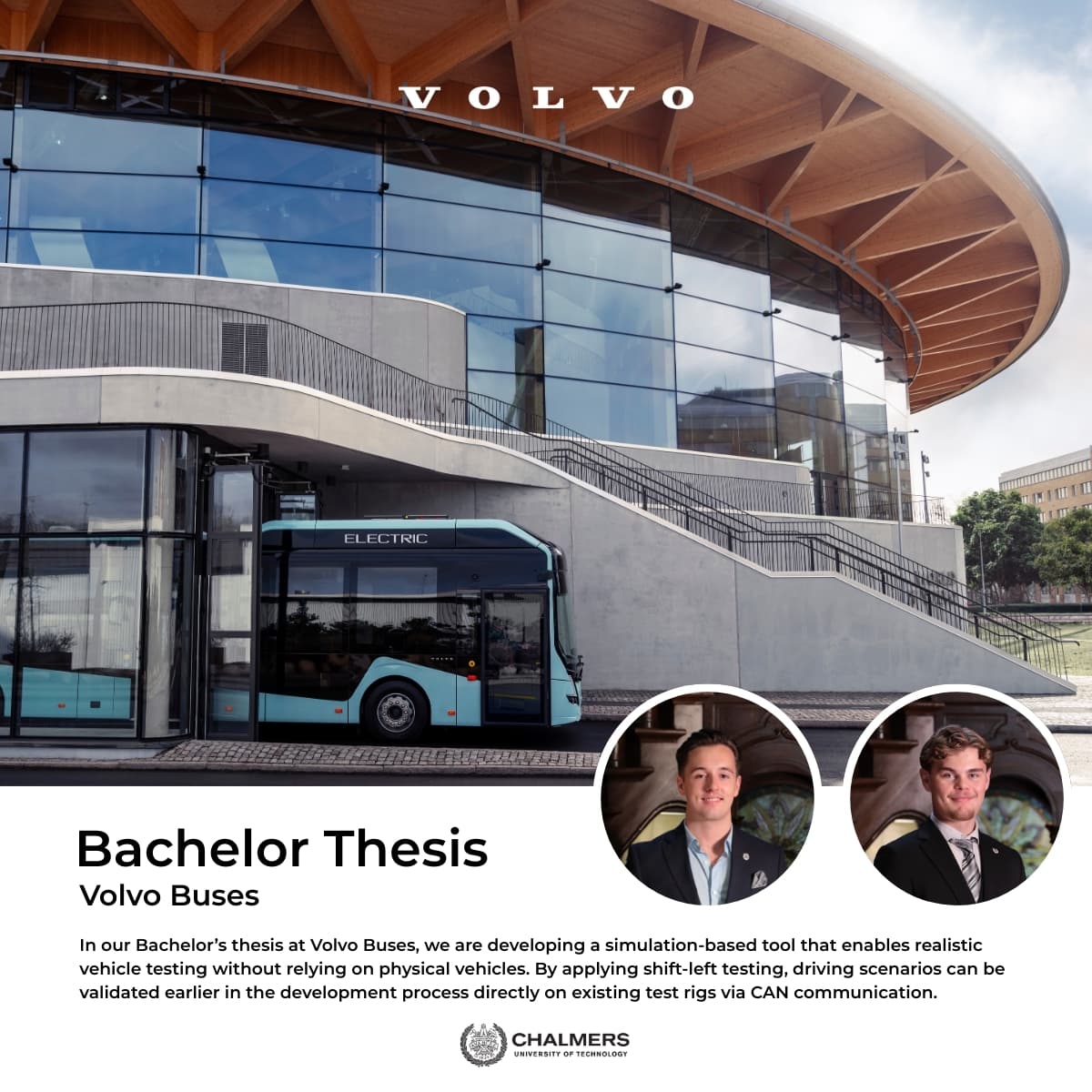
In my bachelor thesis at Volvo Buses, conducted in collaboration with Chalmers University of Technology, I developed a CAN-based vehicle simulation tool for early verification of vehicle behaviour in a laboratory and HIL environment.
The project resulted in a functional prototype combining a software-based vehicle model, a real-time graphical user interface and a CAN communication module. The vehicle model simulates key states such as velocity, acceleration, orientation, gear selection, engine speed, steering behaviour and wheel-related variables.
Simulated vehicle signals were mapped to DBC-defined CAN messages, encoded with python-can and transmitted through a Vector-based CAN interface into the ECUs of an existing test rig. The signal chain was verified both in virtual CAN testing and in a physical HIL/test rig environment, where the generated signals could be observed and analysed in CANalyzer.
The architecture is modular: the driveline is modelled component by component and can be extended with features such as automatic transmission, closed-loop cruise control and a 6-DOF vehicle model. The setup also supports real-time simulation and map-based visualisation for interactive scenario testing.
By shifting verification from proving grounds to the lab, the approach supports shift-left testing: faster feedback loops, repeatable test cases and earlier detection of issues, while reducing the time, cost and resources required for field testing.
After the thesis, the work was extended into a full-time role in May–June 2026, where Vector CANoe was integrated into a larger test environment and advanced tests were developed for safety systems such as AEBS.